Dear Therapist,
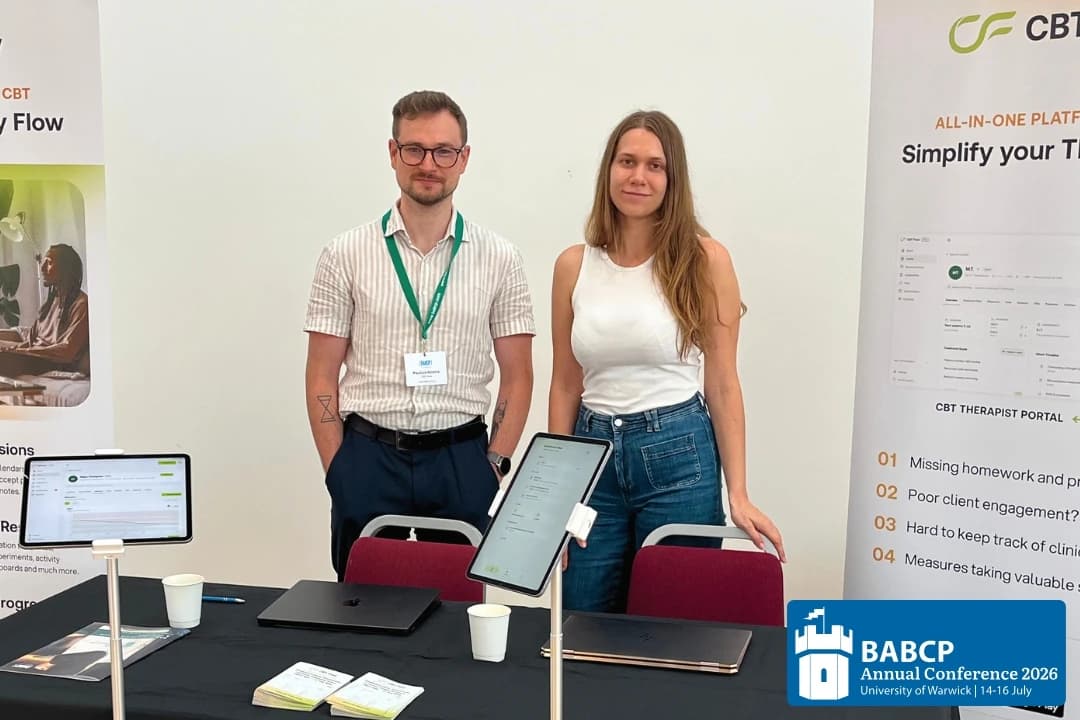
Thanks for stopping by. We’re Rūta and Paul, the co-founders of CBT Flow. Before we explain what we’ve built, we’d like to tell you why we started.
About CBT Flow
CBT Flow is a digital platform designed to help CBT practitioners organise their caseloads and support clients throughout therapy.
The Therapist Portal and Client App work together, giving each client a personalised space for their therapy. Practitioners decide what to share and when, so technology supports the therapeutic relationship without getting in the way.
Our values
Every feature is designed around how CBT is actually delivered — in sessions, between sessions, and across treatment episodes.
Data protection, informed consent, and clinical governance are built into the platform's foundation.
We listen to how therapists work and what they need. CBT Flow is shaped by continuous practitioner feedback.
Protocols, tools, and questionnaires are maintained in line with the latest NICE guidelines and clinical research.
Our story
Dear Therapist,
Thanks for stopping by. We’re Rūta and Paul, the co-founders of CBT Flow. Before we explain what we’ve built, we’d like to tell you why we started.
CBT doesn’t begin or end when the session does — for the therapist or the client. There are notes, measures, worksheets and treatment plans to keep organised, and that’s before scheduling and the rest of the admin. Each part serves a purpose, but keeping everything in order can become a job in itself. We know because we’ve seen it first-hand.
Rūta is a practising CBT therapist and is currently completing further CBT studies at the University of Oxford. Her research journey began earlier, while she was finishing her psychology degree in London. She chose internet-delivered CBT (also known as iCBT) as her thesis topic and later revised the work for publication as a systematic review and meta-analysis. You can access the publication here: https://pubmed.ncbi.nlm.nih.gov/40669868/.
The research found that iCBT can remain effective over the longer term. It also highlighted something important: therapist involvement matters, with guided programmes achieving considerably higher completion rates than self-guided ones.
At a time when technology is often discussed in terms of what it could replace, this reinforced a principle that continues to guide us:
Technology should elevate therapy, not replace it.
But research was only one part of the story.
Rūta’s in-person work required handouts to be prepared in advance, while online sessions meant emailing files that were awkward for clients to complete and return. Tasks were sometimes misplaced or forgotten, and outcome measures were left until the next session—then manually scored and filed.
There was also a growing body of CBT knowledge to keep up with. Protocols, treatment plans and resources all needed to remain relevant, organised and connected to the right case.
Conversations with other therapists confirmed that Rūta’s experience wasn’t unusual. Many wished there were a better digital way to keep everything organised and connected.
Rūta sometimes brought these frustrations to Paul. Our conversations would drift into imagining what a better solution might look like – how information could flow easily from therapist to client and back again. We would talk it through, set it aside and get on with our lives. Yet the same conversation kept resurfacing.
Then, during one of our long road trips — filled, as usual, with heated discussions — Paul asked a different question: what if we built it together?
Paul brings a background in digital product development, automation and user experience. Having been fascinated by tech since his teens, he specialises in turning complex systems into products that feel clear and intuitive to use.
That combination of clinical experience, research and digital-product thinking became CBT Flow.
Deciding to build it was only the beginning. It took time to develop a workflow centred on how practitioners actually work, with relevant information moving clearly from therapist to client and back again.
We also knew that CBT Flow would hold deeply personal information. Safety, security, privacy and compliance couldn’t be added later—they had to shape the platform from day one.
Today, CBT Flow is open to UK practices. If you’d like to see how it could work for you, book a short demo — we’d love to hear from you.
Thanks for reading,
Rūta and Paul
Book a demo, or get in touch to learn how CBT Flow could support your practice.